A Step-by-Step Workshop

How To Turn A 30-Cent Egg From Your Fridge Into A Glowing, Jewel-Colored Keepsake Your Family Will Still Be Displaying Years From Now

An old Ukrainian wax-and-dye craft, taught over my shoulder at a kitchen table.

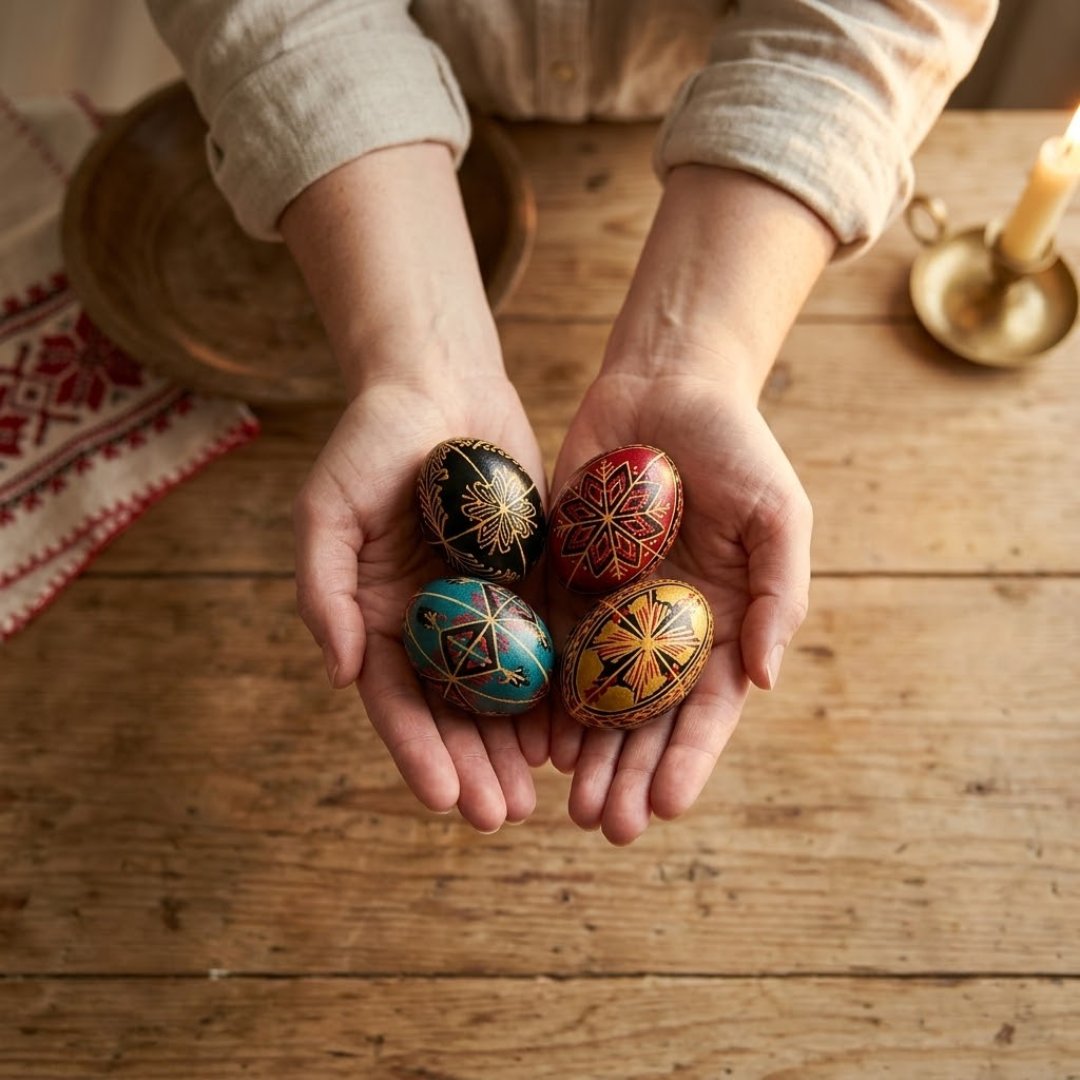
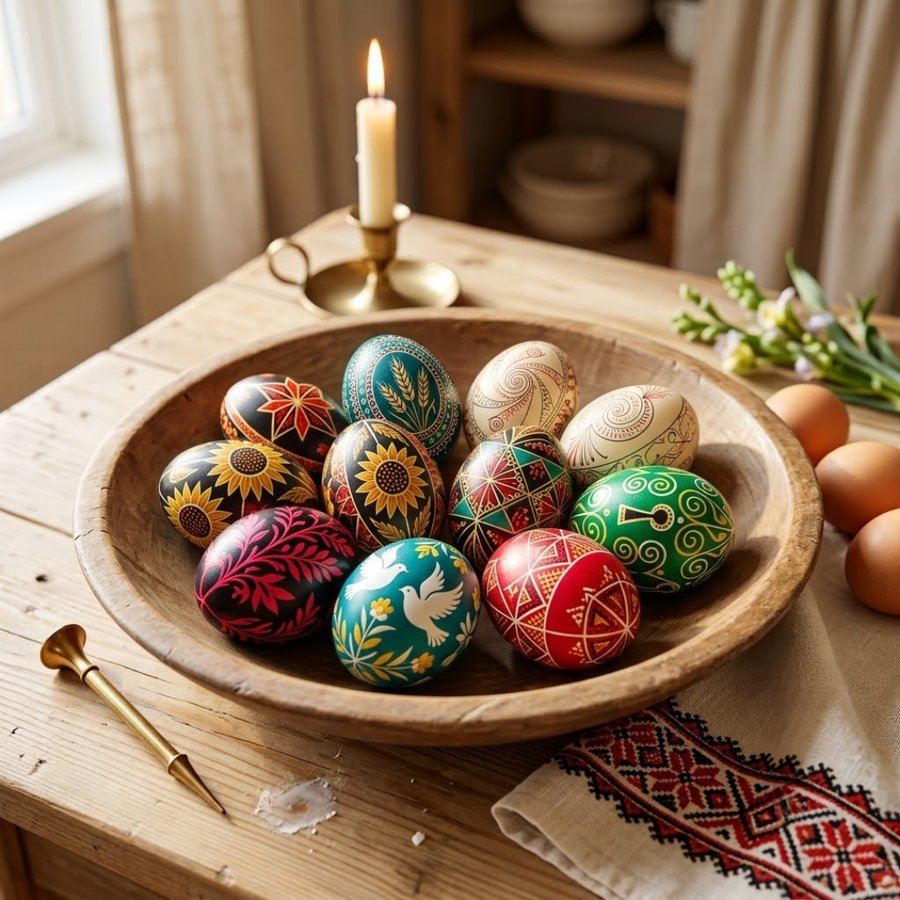
A wooden bowl of finished pysanky eggs in deep reds, teals, greens and golds on a kitchen table beside a lit candle and a brass kistka

Imagine sitting down at your own kitchen table on a quiet evening with one plain white egg from the carton in your fridge, and standing up about three hours later holding something that looks like it belongs behind glass. Deep garnet red. Gold. Black. A band of crisp white geometry wrapping the whole way around it, so clean that people will assume it was printed by a machine.

Imagine setting it in a bowl on the table the next time someone comes over. They pick it up without asking, turn it toward the light, and say "okay, where did you buy this?" And you get to say that you made it.

Now imagine finding out the whole thing was done with a candle, a small tool that costs about as much as a sandwich, and a few cups of dye. That the part everyone assumes takes talent is actually done by a tool that carries the line for you. And that the reason your egg looks like that isn't artistic skill at all. It's knowing the correct order to do things in, and order can be taught in a weekend.

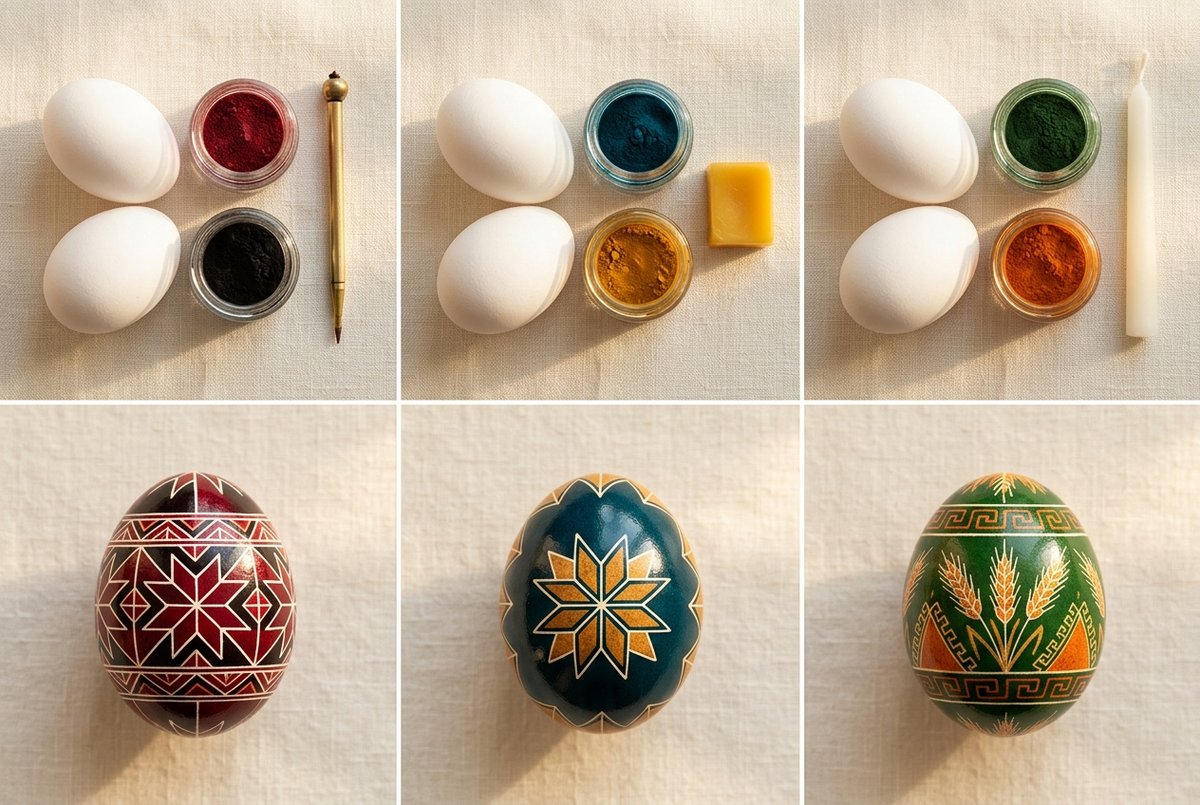
Three sets of plain white eggs with jars of dye in different color families above three matching finished pysanky in garnet red and black, teal and gold, and green and orange

Every Egg Is One of a Kind

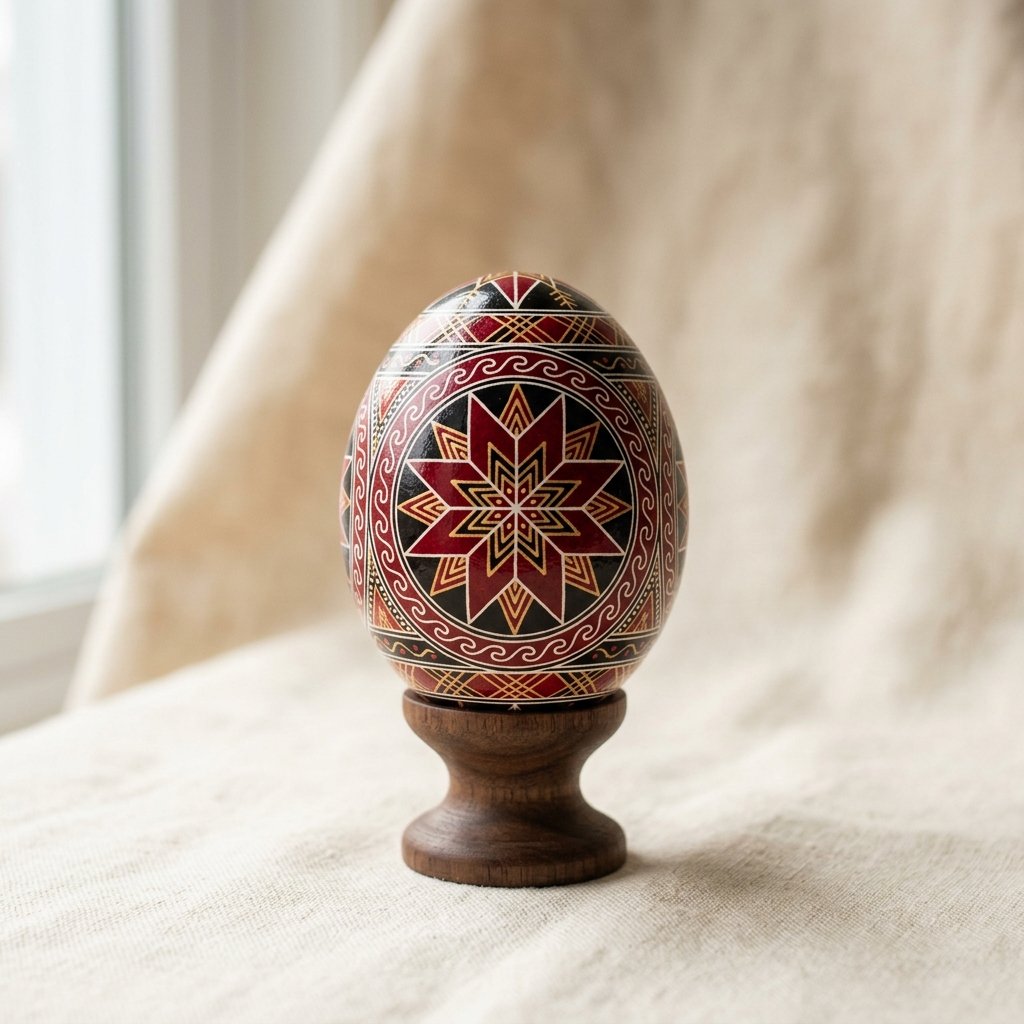
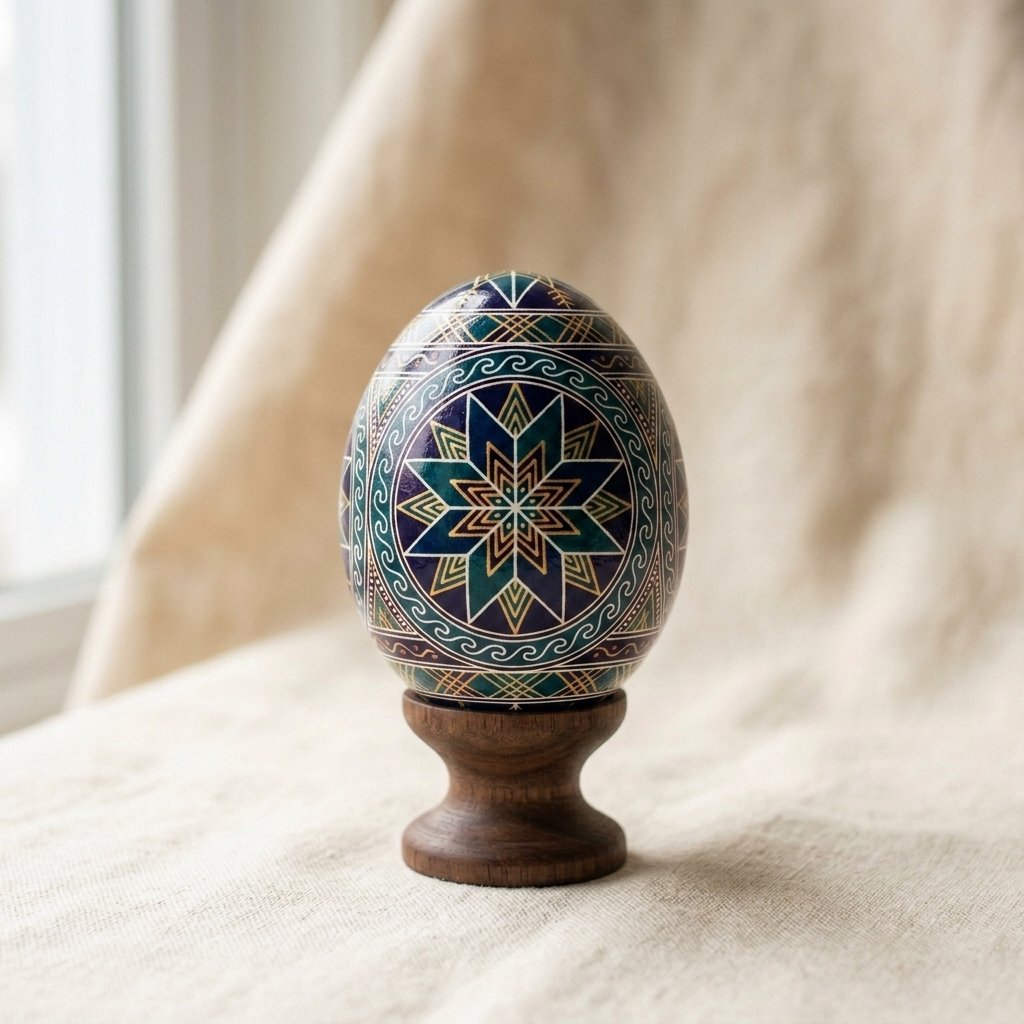
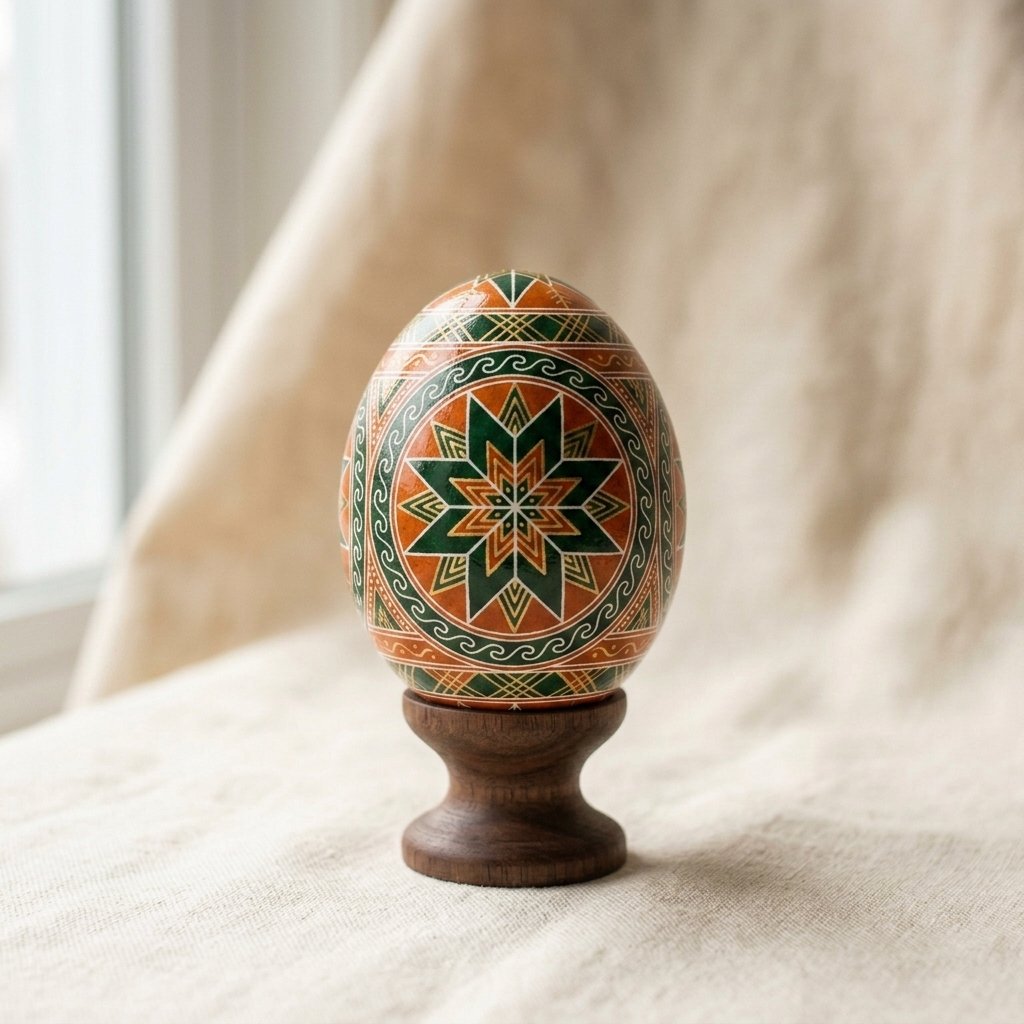
The eight-pointed star below is the same traditional design written three times. The only thing that changed is the order of the dye baths. Deep garnet, midnight blue, spring green. Your dye order is your palette.

A pysanka with an eight-pointed star in traditional garnet red and black on a wooden stand

Traditional Garnet & Black

The same eight-pointed star pysanka design in midnight blue and teal

Midnight Blue & Teal

The same eight-pointed star pysanka design in spring green and orange

Spring Green & Orange

The Part That Looks Like Talent Is Actually a Tool

The first time you see a real pysanka (how to pronounce: pih-SAHN-kah), your brain files it under "things other people can do." The lines are too fine. The pattern is too even. Surely there's a decade of art classes hiding behind that egg.

There isn't. Nothing on a pysanka is drawn freehand. A small brass tool called a kistka carries a thread of melted wax, and the wax carries the line. Your hand just steers. The egg gets divided into simple sections first, with a rubber band and a pencil, and every traditional design falls out of that grid one short stroke at a time.

The colors aren't painted on either. The egg sits in one dye bath after another, and the wax decides which color survives where. What looks like talent is really a sequence, and a sequence is something you can follow.

Which is why every egg at the top of this page started out identical to the white eggs sitting in your fridge right now.

Marta B. laughing in her kitchen, wearing a denim apron and red glasses

Marta B.

Hi, I'm Marta. My great-grandparents came from Ukraine, but I have to be honest with you: nobody in my family taught me this. The tradition skipped two generations, the way traditions do, and I didn't write my first pysanka until I was 36, at a folding table in a church basement, where it came out looking like a bruise. I kept going anyway.

In Ukrainian you say a pysanka is written, not painted, from the word pysaty, to write. If you can write your name, you have every skill this craft asks for. The rest is knowing what order to do things in, and handing you that order is the part I love. If your first egg ends up in a bowl where somebody picks it up and asks where you bought it, that's all I want.

Introducing: The Pysanky Egg Workshop

The Pysanky Egg Workshop course preview showing video lessons and bonus guides across devices

The Pysanky Egg Workshop is my complete weekend class, filmed over my shoulder in close-up, so you're watching my hands from the same angle you see your own. Pause it, rewind it, follow along at your own speed.

By the end, you'll take one plain white egg out of a carton and write a full traditional pysanka on it, start to finish, in one quiet evening, about three hours at the kitchen table. Not a copy of my egg. Yours. You'll understand why every step happens in the order it happens, and that understanding is the whole difference between someone who can follow along with one egg and someone who can sit down with a blank shell and make any egg they can imagine.

Fair warning: you'll also end up with a shelf. It starts as one egg in a bowl, and then the bowl fills up, and then people start requesting their favorites by name.

What You'll Learn

Five video modules. One finished pysanka in your hands by the end of the fifth.

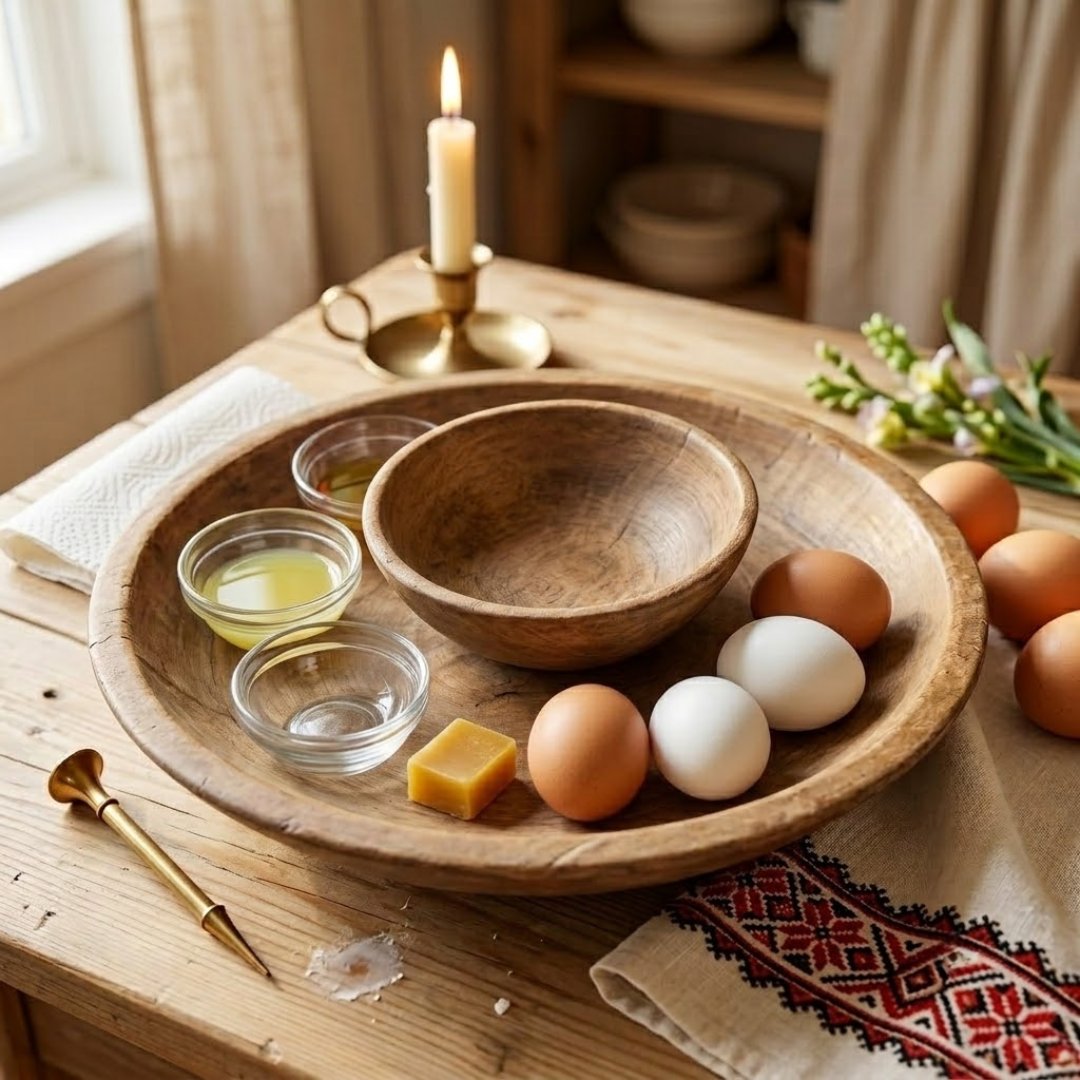
Module 1: the full pysanky supply flat lay with eggs, beeswax, dye cups, a candle and a kistka in a wooden bowl

Module 1

The Thirty-Cent Studio

Meet the kistka (KIST-kah), the little brass-tipped stylus at the heart of this craft, set up your whole studio in a shoebox for under $35, and write your first smooth wax lines the same night.

  • The exact shopping list, down to the brand of dye, and the two things in every beginner kit that do absolutely nothing (skip them and save the money for eggs).
  • The ten-second vinegar rinse that decides whether dye grips your shell or slides off it. Most beginners skip this entirely and then blame the dye.
  • Why you should sacrifice your first egg on purpose, and how one throwaway exercise removes the shaky-hand fear before it ever starts.
  • Do you wash your eggs with dish soap first? That one innocent habit quietly sabotages every egg it touches, and I'll show you what to do instead.
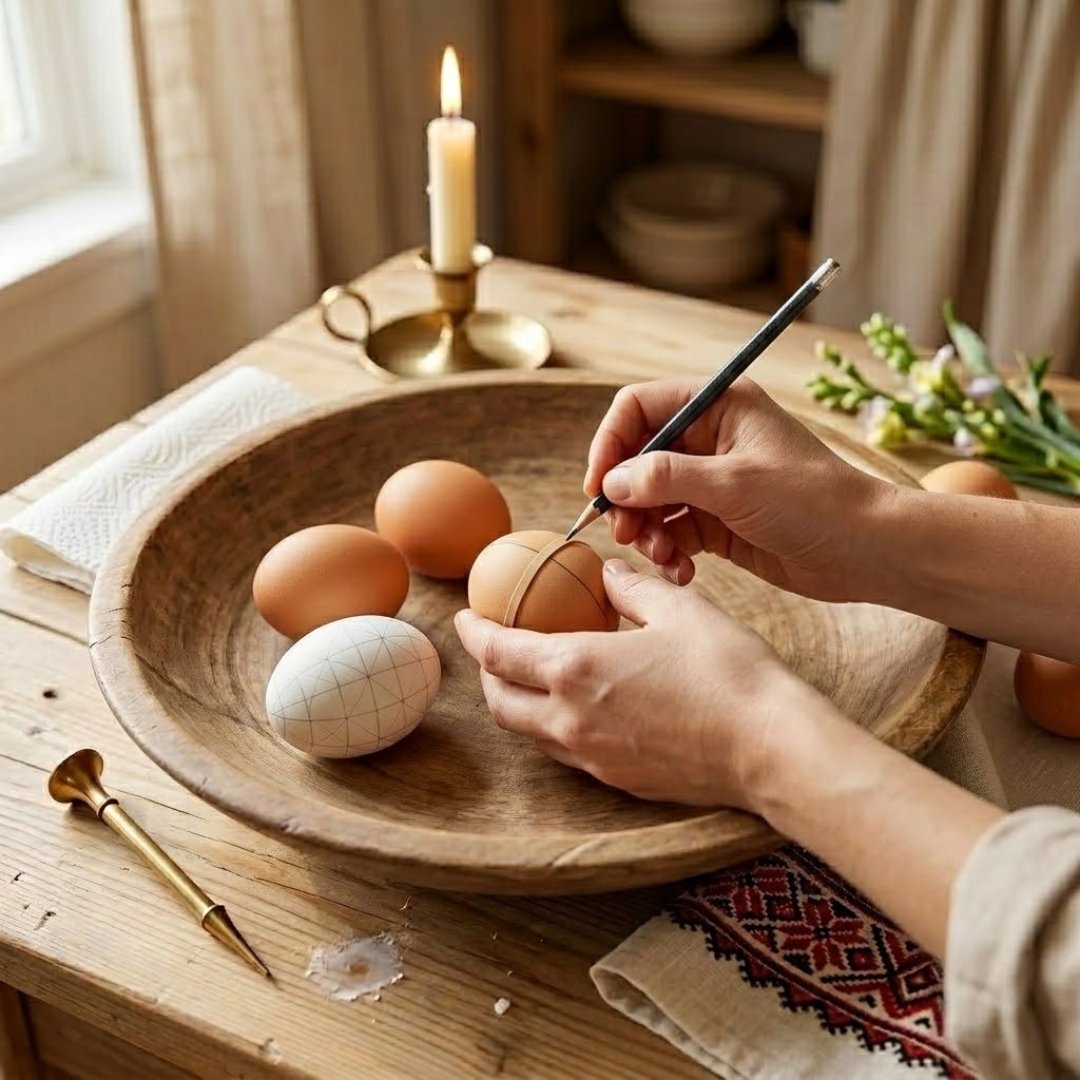
Module 2: hands penciling division lines onto an egg using a rubber band as a guide

Module 2

The Grid That Draws For You

Learn the traditional division-line system that splits any egg into small, simple sections, so complex designs become a series of easy one-inch strokes anyone can make.

  • How to lay perfectly straight lines around a curved egg with nothing but a rubber band and a pencil, in under 90 seconds.
  • The three classic divisions behind almost every traditional design, and the one that makes a first egg look far more advanced than it is.
  • What never to do with your pencil marks unless you want faint ghost lines showing through your finished colors forever.
  • The truth about "having a steady hand." Hint: the division grid quietly corrects a wobble, which is why shaky-handed beginners routinely out-write confident ones.
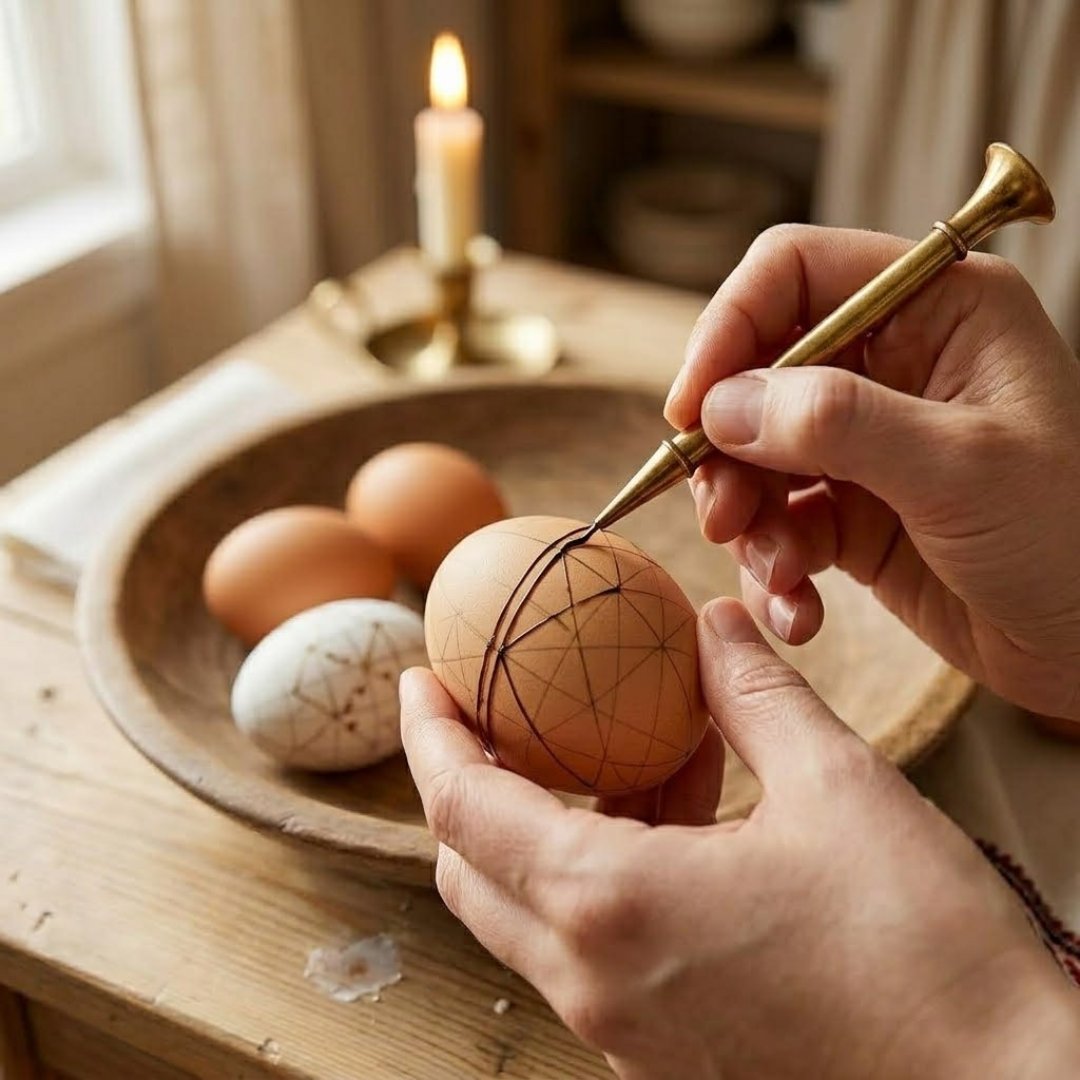
Module 3: a hand writing wax lines on a gridded egg with a brass kistka

Module 3

Writing in Reverse

The one mental flip that separates a muddy brown egg from an heirloom: wax protects color, so the whole design is planned backwards. This is the module the free videos leave out.

  • You think you're drawing a design? You're actually locking in colors one layer at a time, and learning to see it backwards is the entire craft.
  • The single most important decision on the whole egg, and why you make it before you ever light the candle.
  • If you can sort four colors from lightest to darkest, you can plan a pysanka that looks like it took a professional a week. I'll prove it to you on camera.
  • Follow along stroke for stroke as we write and dye your first complete pysanka, start to finish, in one quiet evening.
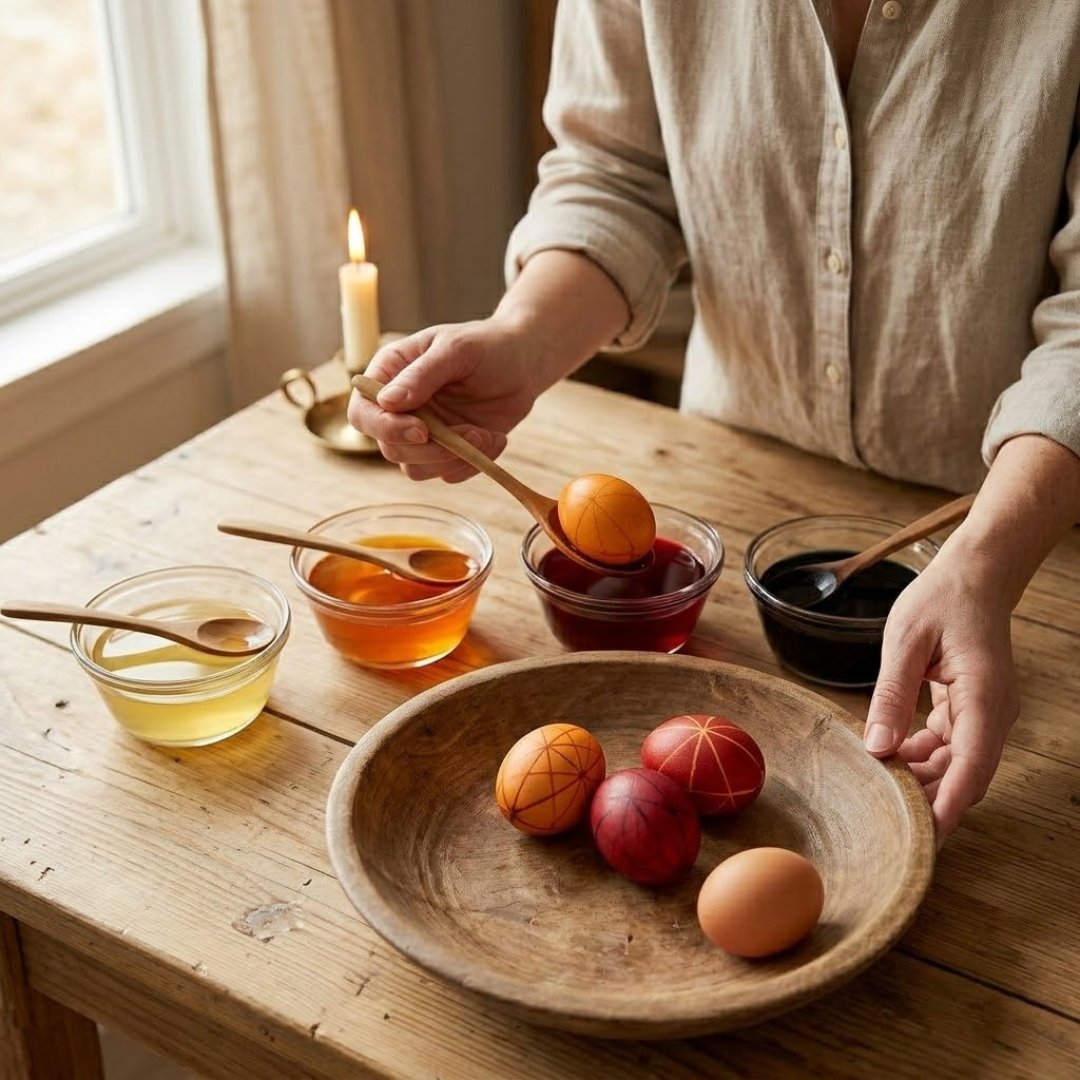
Module 4: lifting a waxed egg out of a row of dye baths arranged from light yellow to black

Module 4

The Dye Bath Order

Ten quiet minutes in which most eggs are ruined, and the person holding them won't find out for another two hours. Here's how yours survives every single bath.

  • The unbreakable light-to-dark rule, and the simple memory trick that means you will never again ruin an egg by dyeing out of sequence.
  • What never to do when your egg floats. Handle it wrong and you get a bald stripe across your best panel, and there is no fixing it.
  • How to pull a red so deep and even it glows, out of a 90-cent packet of dye. It's about timing and vinegar, not luck.
  • How to know exactly when to lift the egg out of each bath, without guessing and without staring at a timer.
Module 5: two hands holding four finished pysanky in black, red, teal and gold

Module 5

The Reveal

The ten minutes everything else was for. The wax melts away, every color you buried arrives at once, and this is the moment people film.

  • The correct distance to hold your egg from the flame. Too close and you scorch a permanent brown ghost into the shell that no wiping will ever lift.
  • Empty the egg or leave it whole? Both work. Learn the old-country method where a raw egg quietly dries to a harmless rattle, plus the modern four-minute alternative if you'd rather not wait.
  • The emptying technique that leaves a hole so small you'll have to hunt to find it on the finished egg.
  • The professional-looking glossy finish is a fingertip of varnish and a nail pushed through a scrap of cardboard. That's it. That's the whole secret.

4 Free Bonuses (Included Today)

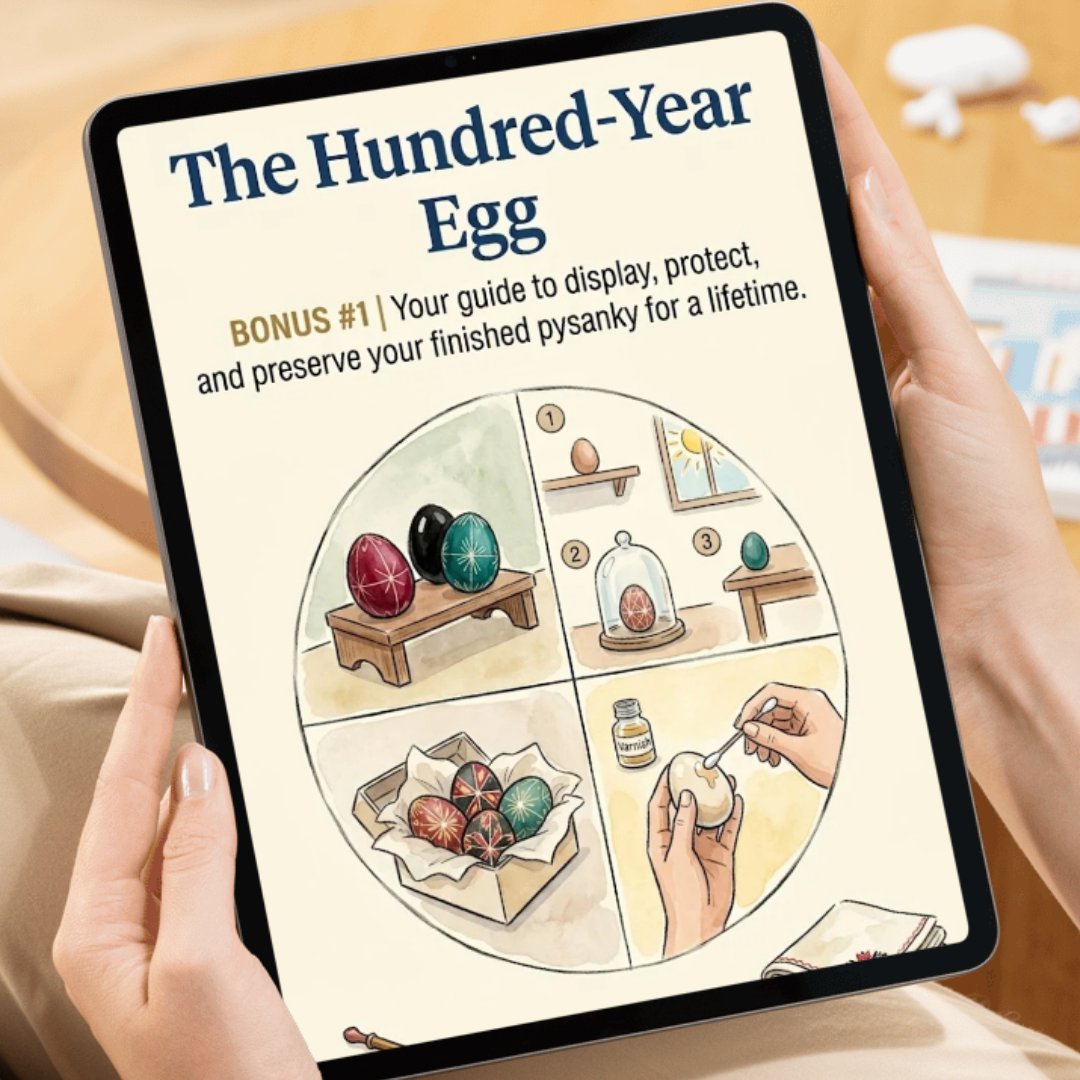
FREE Bonus Bonus 1: The Hundred-Year Egg guide shown on a tablet

$19 Value. Yours FREE

The Hundred-Year Egg

You made it. Now it has to survive your house. This short guide keeps your work intact, unfaded, and out of the dustpan.

  • Why a pysanka that survived four generations abroad can fade to nothing in one summer on a sunny shelf, and the free fix.
  • How to display a hollow egg where a cat, a toddler, and a slammed door can't reach it, without hiding it in a drawer where nobody sees it.
  • The one storage material sitting in every craft aisle that will quietly destroy your best work. Never let your eggs touch it.
FREE Bonus Bonus 2: Written For You, the pysanky symbol dictionary shown on a tablet

$19 Value. Yours FREE

Written For You: The Symbol Dictionary

Every motif on a traditional pysanka carries a meaning: stars, deer, wheat, endless lines. Which means you can build an egg around one specific person and hand them something that reads like a letter. This is the part that makes people tear up at the table.

  • The 12 traditional symbols with real meaning behind them, and the 3 that people put on eggs constantly without any idea what they're saying.
  • Give me the name of someone you love and I'll show you how to plan their entire egg around them in about four minutes.
  • How to write the little card that goes with a gifted egg, so the person holding it understands exactly what they're holding.
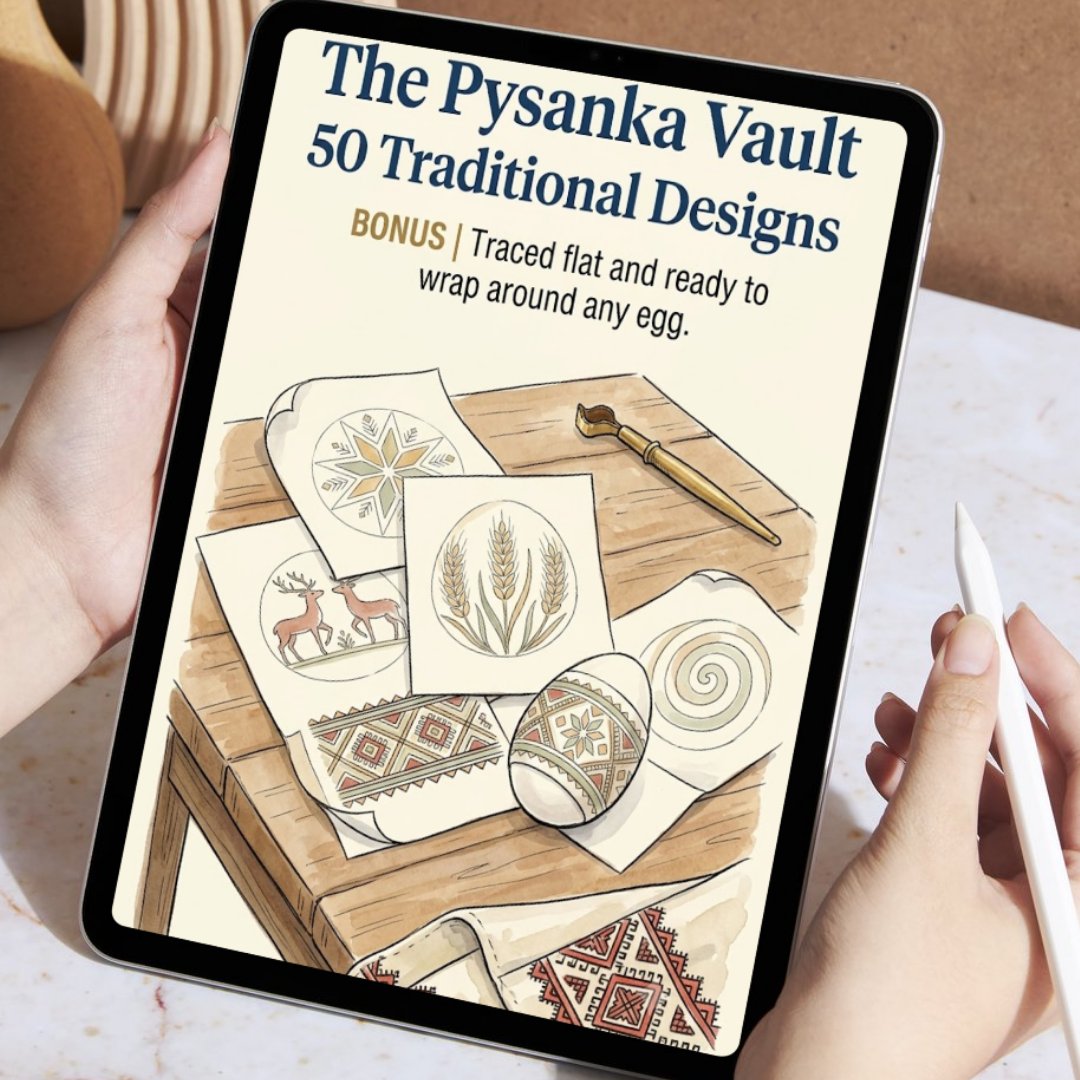
FREE Bonus Bonus 3: The Pysanka Vault of 50 traditional designs shown on a tablet

$29 Value. Yours FREE

The Pysanka Vault: 50 Traditional Designs, Traced Flat And Ready To Wrap

Fifty traditional designs drawn out flat, panel by panel, with the full dye order printed right on the sheet. Print one, wrap it around your egg, and write. You will not run out of ideas for years, and you'll never again sit down in front of a blank white shell with no plan.

  • If you can wrap a piece of paper around an egg, you can write a design that took generations to refine.
  • Every sheet includes its own light-to-dark dye order, so you're planning in reverse like a veteran from day one.
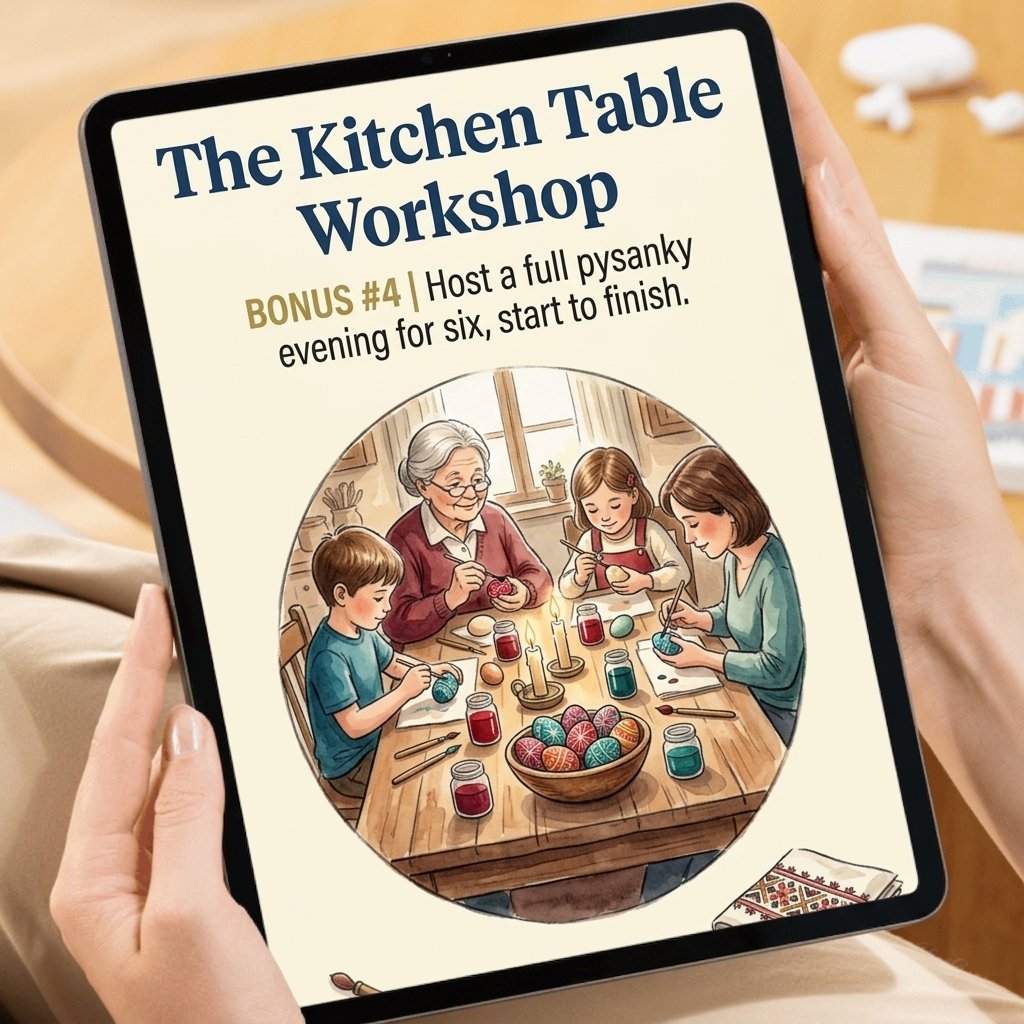
FREE Bonus Bonus 4: The Kitchen Table Workshop hosting guide shown on a tablet

$29 Value. Yours FREE

The Kitchen Table Workshop

Once your bowl starts filling up, people will ask you to show them how. This is a full pysanky evening for six, planned end to end: setup, seating, timing, and the one job you never hand to a child.

  • How to run a full pysanky night for six people, kids included, in a kitchen that has to be clean again by bedtime.
  • The 3 steps you can safely hand a seven-year-old, and the 1 you never let them near.
  • Have a friend or relative who insists they "aren't creative"? Here's the exact first egg to put in front of them so they prove themselves wrong inside twenty minutes.

For Just $47 You Get Everything

The price of The Pysanky Egg Workshop is $97. That's what it costs, and that's what it will cost. But it's not what you're paying today.

Here's the honest reason why. The course itself is finished. Every video is shot, edited, and sitting on the server waiting for you. What I don't know yet is how many students I can personally look after at once. Sitting next to someone, I can unclog a kistka in four seconds. Through a screen, all I have is answering your emails properly, and I don't know how many of those I can answer well in a week before I start answering them badly.

So I'm opening the first 100 spots at $47 instead of $97, purely to find out. If I can give 100 people the attention they paid for, this page goes to $97 and stays there. Compare that to a single in-person evening class, which runs $65 to $85 for one egg and one sitting, no replays and no way to ask a question next Tuesday. You're getting the whole workshop, for keeps, for less than one night out.

Everything included in The Pysanky Egg Workshop: five video modules and four bonus guides
  • The Complete Pysanky Egg Workshop $97 value
  • Bonus #1: The Hundred-Year Egg $19 value, FREE
  • Bonus #2: Written For You: The Symbol Dictionary $19 value, FREE
  • Bonus #3: The Pysanka Vault (50 Traditional Designs) $29 value, FREE
  • Bonus #4: The Kitchen Table Workshop $29 value, FREE
Total Value: $193
You Pay Today: $47

One-Time Purchase. Lifetime Access.

$97 $47
Start Writing Your First Pysanka Now
🔒 Secure Checkout 💳 All Cards Accepted ✓ 30-Day Money Back

Lock in the founding $47 price while the first 100 spots last.

Maybe You're Thinking...

"But I genuinely can't draw." Good, because you won't be. A rubber band and a pencil divide the egg into a grid, and every design is short strokes on that grid. The slight wobble of a human hand is the reason a real pysanka looks alive instead of printed.

"I'll crack the eggs and waste my money." You'll crack a couple. Eggs cost about thirty cents, which makes this arguably the cheapest craft on earth to be bad at while you learn. I'll also show you how to hold, lower, and lift an egg so nearly all of them survive every dye bath.

"Isn't this just an Easter decoration?" A finished pysanka isn't something you throw out in April. It sits in a bowl on the shelf in December the same as it does in spring, and it gets handed down. Nobody who picks one up thinks about the calendar.

30-DAY GUARANTEE

The First Dozen Promise

You don't have to decide anything today. Get in, watch the whole workshop, and try it on a dozen eggs, a whole carton, at your own kitchen table. If you don't love what's sitting in your bowl, email me any time in the next 30 days and your money is back within 24 hours of your message. NO QUESTIONS ASKED. You keep every bonus. I would honestly rather you tried this and walked away than spent another year looking at pictures of it and wondering.

Frequently Asked Questions

This is the first thing everyone asks and the answer is easier than you'd think. You have two options and I cover both. The traditional way leaves the raw egg inside, and in an intact shell it dries down to a hard little rattle over about a year without ever smelling. The modern way empties the egg in roughly four minutes at the end, through a hole you'll have to hunt for to find afterward. Most of my students empty them. Nothing in your house is going to smell like anything.

No experience, and no drawing. You aren't drawing freehand at any point. The egg divides itself into a grid with a rubber band and a pencil, and every design is built on that grid. Nearly everyone starts by telling me they can't draw, and they finish with an egg anyway. If your hands shake a little, there's a way to brace them in module two, and it's the same thing I do.

A kistka (the wax tool, about $12), a block of beeswax, a set of aniline dyes, a candle, white vinegar, paper towels, and eggs. That's roughly $30 to $35 for the whole setup, and the dyes will carry you well past a hundred eggs. Module one walks through the full shopping list and flags what to skip. You don't need a kit, a kiln, a workspace, or anything that plugs into a wall.

The workshop is a little under four hours of video, but it isn't meant to be watched like a movie. Most people get through modules one and two in an evening and start the same night. Your first egg takes about three hours. And if you only ever have 30 minutes at a stretch, that's fine too, because a waxed egg will sit on the counter for days waiting for you to come back.

Yes, one payment. There is no subscription, no monthly fee, no second charge, no hidden anything. You pay $47 once and that's the last time this ever costs you money.

Email me any time in the first 30 days and I'll refund you within 24 hours of your message. You keep the bonuses. I'm not going to argue with you about an egg.

Forever. It's yours, lifetime access, watch every video as many times as you want. People come back to the dye order module for years, which is exactly what it's there for.

Pre-recorded video you stream from any browser, on a phone, tablet, laptop, or TV. It's shot from over my shoulder so you're seeing my hands at the same angle you see your own. There's also a printable one-page dye order sheet you can prop against the sugar bowl while you work, because nobody wants to touch a laptop with waxy fingers.

There's a lot of good free pysanky content out there and I'd never tell you otherwise. What almost none of it does is explain the logic, because it's built to be watched and copied. Follow a video and you'll produce a copy of that person's egg. What you still won't be able to do is sit down in front of a blank shell with your own idea and know what to wax first. That's the difference, and that's what module three is.

Checkout is SSL encrypted and handled by Stripe and PayPal, the same processors running your Amazon orders. I never see your card number and neither does anyone on my end. You're covered by the 30-day guarantee on top of that.

The moment you pay, the next page has your login on it, and the entire workshop plus every bonus is sitting there waiting. If you've got eggs in the fridge and a candle in a drawer, you can be writing wax tonight.

Email me. That's the whole reason the price is what it is right now, and the whole reason I'm capping this at 100 people. You get me, personally, answering your actual question about your actual egg. There's also a private group where students post their eggs, and honestly the beginners in there tend to answer faster than I do.

Ready to Write Your First Five-Color Pysanka?

The tradition that made these eggs skipped two whole generations of my family before it reached me, and all it took to pick it back up was one quiet evening at a folding table. You already own the first supply. It's sitting in a carton on the second shelf of your refrigerator. I'd love to show you what it can turn into.

Marta B.

One-Time Purchase. Lifetime Access.

$97 $47
Start Writing Your First Pysanka Now
🔒 Secure Checkout 💳 All Cards Accepted ✓ 30-Day Money Back

Lock in the founding $47 price while the first 100 spots last.